
My Struggle (and Small Victories) with German B1.2: Online Lectures
Okay, so, here I am. Six months in Germany, and let’s just say my German is…developing. It’s definitely gotten better, but I still feel like I’m wading through molasses sometimes. Right now, I’m focusing on the TELC B1.2 exam, specifically the “Bildbeschreibung” (image description) section. It seems deceptively simple, but it’s really hitting me with the need to actually understand what people are saying, not just parrot phrases.
The Lecture Scenario – And My Initial Panic
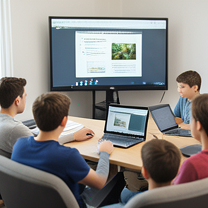
The B1.2 Bildbeschreibung test shows a picture of students in an online university lecture. It’s a pretty common scene – a guy in a hoodie looking slightly bored, a girl with headphones on taking notes, a professor gesturing with a whiteboard behind them. I thought, “Okay, easy, I can describe that!” But then I started the practice test, and the questions were so specific. “Welche Farbe hat der Pullover des Studenten?” (What color is the student’s sweater?) “Welche Tätigkeit verrichtet die Studentin?” (What activity is the student doing?). I froze. Seriously, froze. My initial reaction was just a frantic, “Ich weiß nicht!” (I don’t know!)
Common Phrases I’ve Learned (and Still Mess Up)
Let’s talk about some phrases I’m actually using now, though I still stumble over them. They’re the ones that feel the most helpful when I’m really trying to describe something.
- “Er/Sie trägt…” (He/She is wearing…) – “Er trägt eine blaue Hose.” (He is wearing blue jeans.) – I still get the gender wrong sometimes! It’s so easy to mix up er and sie.
- “Er/Sie scheint…” (He/She seems…) – “Er scheint gelangweilt zu sein.” (He seems bored.) – This is a big one for me. I need to watch my tone of voice when I say it – it feels a bit forced.
- “Der/Die/Das…” (The…) – “Das ist eine Tafel.” (That is a whiteboard.) – Again, I’m constantly reminding myself about the articles! It’s a fundamental thing I keep forgetting.
A Real Conversation (And My Embarrassing Mistake)
Yesterday, I was in a café with some colleagues – mostly other expats, which is reassuring – and we were talking about university lectures. I wanted to express that the lecturer seemed a little stressed. I attempted, “Der Professor ist sehr gestresst!” (The professor is very stressed!). My colleague, Klaus, gently corrected me. “Nicht ‘der Professor,’ sondern ‘er.’ Er ist gestresst.” (Not ‘the professor,’ but ‘he.’ He is stressed.) I felt my face burn. It’s these little things that highlight just how much I still have to learn. I wanted to defend my phrasing, but I realized he was right. I needed to listen more carefully.
Vocabulary for the Picture: Key Words
Let’s break down the specific vocabulary I’m working on for the B1.2 picture:
- Laptop: Laptop (obviously!) – “Sie benutzt einen Laptop.” (She is using a laptop.)
- Headphones: Kopfhörer – “Er trägt Kopfhörer.” (He is wearing headphones.)
- Whiteboard: Tafel – “Der Professor schreibt auf der Tafel.” (The professor is writing on the whiteboard.)
- Pullover/Sweater: Pullover – “Er trägt einen Pullover.” (He is wearing a sweater.)
- Langweilig: Langweilig – “Er scheint langweilig zu sein.” (He seems bored)
Misunderstandings and Correction – Learning from My Errors
I once tried to describe a student taking notes as “schnell schreiben” (writing quickly). My tutor, Alice, stopped me immediately. “Nein, nein! Sie notiert! Sie schreibt Notizen!” (No, no! She takes notes! She is writing notes!). The difference is subtle, but it demonstrates how important it is to understand the context and use the correct verb.
Small Steps, Big Progress
Despite the frustrations, I’m actually starting to see progress. I can now confidently describe the B1.2 picture in German, even if I occasionally stumble over my words. More importantly, I’m building confidence in my ability to communicate. The TELC B1.2 exam isn’t just about testing my vocabulary; it’s about proving to myself that I’m capable of understanding and being understood in this new language and culture. “Weiter so!” (Keep it up!).

Leave a Reply