
My German Journey: Tackling the B1.2 with Maps and Backpackers
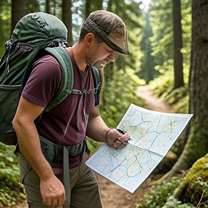
Okay, so here I am, a few months into living in Berlin, and honestly, German is… a beast. But it’s a rewarding beast, you know? It’s frustrating, hilarious, and sometimes completely overwhelming. I’m working as a freelance translator, which is great, but it also means I constantly need to understand directions, booking travel, and generally figuring out where I am. That’s why I’ve been focusing specifically on the TELC B1.2 level, and this image – backpackers planning a route on a map – has become a really useful little training ground.
The Initial Confusion – “Wo sind wir?”
The first time I saw the image, I just felt lost. The guys were huddled around the map, pointing, shouting… it was chaotic! I instinctively asked my colleague, Steven, “Entschuldigung, wo sind wir hier?” (Excuse me, where are we here?). He looked at me with this patient, slightly amused expression and said, “Du bist in der Hackeschen Höfe, Alice. Wir planen unsere Route nach Rostock.” (You are in the Hackeschen Höfe, Alice. We’re planning our route to Rostock). I felt a huge wave of relief, but then realized I hadn’t understood him properly. I’d just parroted the location, not really grasped the conversation.
Key Vocabulary: Location, Direction, Distance
This image really hammered home some key vocabulary I’d been struggling with. “Geradeaus” (straight ahead) became my mantra. I kept repeating it when I was lost, trying to mimic Steven. “Gehen Sie geradewegs!” (Go straight!). It felt incredibly silly at first, but it actually helped. I started learning about prepositions of location – “links” (left), “rechts” (right), “vor” (in front of), “hinter” (behind), “neben” (next to). “Ist das Café neben dem Park?” (Is the café next to the park?). Asking these simple questions felt like a real breakthrough.
Practical Dialogue – Booking a Taxi
Last week, I needed to get to a meeting in Potsdam. I called a taxi company and, of course, got completely tangled in the language. Here’s how it went (roughly):
Me: “Ich brauche einen Taxi nach Potsdam, bitte.” (I need a taxi to Potsdam, please.)
Taxi Driver: “Okay, wie weit möchten Sie fahren?” (Okay, how far would you like to go?)
Me: “Es ist ungefähr… zwanzig Minuten? Und können Sie mich zum Bahnhof bringen?” (It’s approximately… twenty minutes? And can you take me to the train station?)
Taxi Driver: “Ja, kein Problem. Dann fahren wir geradewegs die Hauptstraße entlang.” (Yes, no problem. Then we’ll go straight down Hauptstraße).
Me: “Vielen Dank!” (Thank you very much!)
I stumbled a lot, using “ich glaube” (I think) and “vielleicht” (maybe) constantly. I realized that even if I didn’t say it perfectly, they understood my intention. It’s about trying.
Common Mistakes & How to Fix Them
One of my biggest struggles is with numbers and giving directions. I kept getting confused with “eine” (one) and “zwei” (two). I asked a shopkeeper, “Wie viel kostet das?” (How much does this cost?) and he looked completely baffled when I said, “Zwei Euro, bitte?” (Two euros, please?). He patiently corrected me, saying “Neun Euro, Alice!” (Nine euros, Alice!). I learned to slow down and really focus on hearing the numbers clearly. Also, using gestures – pointing at things – helps enormously!
Learning from the Backpackers’ Enthusiasm
Watching the backpackers in the picture, I realized how genuinely excited they were about their trip. That enthusiasm – “Oh, wir müssen unbedingt nach Schwerin!” (Oh, we absolutely have to go to Schwerin!) – is contagious. I’m trying to bring that same level of excitement to my own learning. It makes the challenges feel less daunting.
Moving Forward – TELC B1.2 and Beyond
This image has been a brilliant little catalyst. It’s forced me to focus on practical vocabulary and realistic conversations. I’m still making mistakes, but I’m learning to laugh at them. The TELC B1.2 exam feels less like a hurdle and more like a checkpoint on my journey. “Los geht’s!” (Let’s go!) – I’m ready to keep planning my routes, both literally and in my German language skills. Next up? Learning how to order food at a restaurant… Wish me luck! “Ich drücke Ihnen die Daumen!” (I’m crossing my fingers for you!).


Leave a Reply