
My German Journey: Tackling the B1.2 Bildbeschreibung
Okay, so here I am, six months in Berlin. It’s… intense. The language, the bureaucracy, the sheer amount of everything! I’m still constantly feeling like I’m wading through a very deep puddle of confusion, but I’m getting there. And honestly, my TELC B1.2 Bildbeschreibung exam is really pushing me to improve my listening and speaking – especially when it comes to understanding everyday conversations.
The Scenario: A Family’s Big Decision
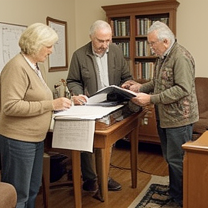
The exam image is always the same: a family – Dad, Mum, a teenage son, and a younger daughter – gathered around a large table, looking stressed and serious. They’re clearly discussing a major purchase, probably a car. It’s a really common situation, and it’s forced me to actually think about how Germans talk about money and big decisions.
I found the initial conversations really difficult. It wasn’t just about understanding the words; it was about understanding the tone and the unspoken implications.
First Attempts & Embarrassing Mistakes
My first attempts to describe the scene were… disastrous. I started shouting “Auto! Auto! Sehr teuer!” (Car! Car! Very expensive!), which, while technically correct, sounded incredibly frantic and completely inappropriate. My German friend, Steven, pointed out that shouting wouldn’t be how anyone would actually say it. He was right, of course.
“Entschuldigung,” he said, “You need to be calmer. Germans tend to discuss these things more rationally. It’s not about shouting, it’s about weighing options.”
He gave me a simple example: “Wir müssen überlegen, ob wir ein neues Auto kaufen sollen. Es ist eine grosse Entscheidung.” (We need to think about whether we should buy a new car. It’s a big decision.) – A completely natural way to begin the conversation.
Key Phrases & Vocabulary
So, I started focusing on the key phrases. Here are a few that have been really helpful:
- “Wie viel kostet das?” (How much does that cost?) – I use this constantly.
- “Ist das ein gutes Angebot?” (Is that a good offer?) – This is essential when evaluating a purchase.
- “Ich finde das zu teuer.” (I think that’s too expensive.) – I’ve practiced saying this politely, which is crucial in German culture!
- “Was sind die Vor- und Nachteile?” (What are the advantages and disadvantages?) – A great question to ask before making a decision.
- “Ich bin mir noch nicht sicher.” (I’m not sure yet.) – Very important to express uncertainty without seeming rude.
I also learned words like “Finanzierung” (financing), “Ratenzahlung” (instalments), and “Leasing” (leasing), which were thrown around in the dialogue. I’m slowly building my vocabulary around these topics.
Dialogue Practice – My Mishaps (and Improvements!)
I started practicing dialogues with Steven. One time, I was trying to express that the car was “schön” (beautiful), but I said “schön, aber teuer” (beautiful, but expensive). Steven laughed and explained that “schön” is generally used for describing something aesthetically pleasing, not necessarily its price. He helped me realise the importance of choosing the right adjective!
A more successful attempt: “Das Auto ist sehr modern und komfortabel.” (The car is very modern and comfortable.) – Much better!
Understanding Tone & Context
The biggest challenge hasn’t been the individual words; it’s been picking up on the tone. The parents are clearly trying to be objective, but there’s an underlying tension. The son seems hesitant, and the daughter is excited. Learning to interpret these nuances has been incredibly helpful.
For example, when the father says, “Wir müssen realistisch sein” (We need to be realistic), it’s not just about the money; it’s about the family’s priorities and what they can actually afford.
Applying What I’ve Learned
I’ve started using these phrases and vocabulary in my everyday conversations. I went to a car dealership last week (it was terrifying!), and I was able to use phrases like “Wie viel kostet die Versicherung?” (How much does the insurance cost?) Even though I still stumbled over my words, it felt amazing to actually put my learning into practice.
Final Thoughts for Fellow Learners
The TELC B1.2 Bildbeschreibung exam is a fantastic tool for improving your listening comprehension and conversational skills. Don’t just focus on memorizing vocabulary; pay attention to how Germans talk about money, decisions, and everyday situations. And don’t be afraid to make mistakes! That’s how you learn. “Fehler sind wichtig!” (Mistakes are important!). Keep practicing, and you’ll be surprised at how quickly you improve. Ich drücke euch die Daumen! (I’m rooting for you!)


Leave a Reply