
Mastering Medical German: My Journey to B1.2 with the Doctor Picture
Okay, so here I am, six months in Munich, and let’s be honest, navigating the healthcare system has been…an experience. It’s fantastic to be here, truly, but understanding the conversations, particularly when it comes to my health, felt incredibly daunting at first. That’s when I realised I needed to seriously ramp up my German, specifically focusing on the kind of language used in medical situations – the kind covered in the TELC B1.2 Bildbeschreibung exams. This article is about how I’m tackling it, and hopefully, it’ll help you too.
The Picture: A Starting Point
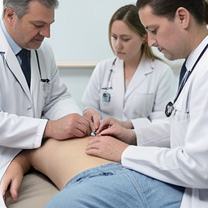
The B1.2 picture shows a doctor and a patient discussing a treatment plan. It’s a really common scenario, and surprisingly, it’s a fantastic springboard for learning. It’s not just about recognizing words; it’s about understanding how people communicate about health issues. The initial panic I felt just thinking about a doctor’s appointment vanished when I started to focus on this particular image.
Key Phrases and Vocabulary
Let’s break down some of the key phrases I’ve picked up. It’s not just “Ich habe Schmerzen” (I have pain) – although that’s definitely essential. I’ve found these incredibly useful:
- “Wie fühlen Sie sich?” (How are you feeling?) – This is the go-to question. I used to just stare blankly, but now I can respond: “Mir geht es gut, aber ich habe Kopfschmerzen” (I’m feeling fine, but I have a headache).
- “Was sind die Symptome?” (What are the symptoms?) – Crucial for explaining what’s wrong. I learned this when I had a bad cough – “Ich habe Husten und mir ist kalt” (I have a cough and I’m feeling cold).
- “Welche Behandlungsmöglichkeiten gibt es?” (What treatment options are there?) – This is a really important question to ask. The doctor explained that there were several options, from medication to physiotherapy.
- “Ich möchte die Risiken und Vorteile besprechen.” (I would like to discuss the risks and benefits.) – I’ve used this a few times to ensure I fully understand what I’m agreeing to.
Real-Life Conversations – And My Mistakes!
My first appointment was… stressful. I tried to be incredibly polite, using all the phrases I’d learned, and I completely stumbled over my words. The doctor, a very kind Frau Schmidt, was patient, but I realized I was relying too much on simple phrases and not enough on understanding the flow of the conversation.
Here’s a little snippet of what happened (translated roughly):
- Frau Schmidt: “Also, erzählen Sie mir, was genau fühlen Sie?” (So, tell me, what exactly do you feel?)
- Me (Panicked): “Ich habe…Schmerzen! Sehr viele Schmerzen!” (I have…pain! Very much pain!)
- Frau Schmidt: “Wo genau haben Sie Schmerzen?” (Where exactly do you have pain?)
- Me (Still flustered): “Im Rücken!” (In my back!)
She gently corrected me and asked me to point to where I felt the pain. I realized I needed to be more specific. It’s about precision, not just shouting “Schmerzen!”
Dealing with Misunderstandings and Asking for Clarification
One of the biggest challenges is that even when I think I understand, I often don’t. German can be so indirect! I once heard the doctor say something like, “Wir sollten die Sache beobachten” (We should observe the situation), and I completely misinterpreted it. I was convinced he was saying everything was going to get worse! I had to politely ask, “Was meinen Sie genau?” (What do you mean exactly?) It’s okay to not understand – showing you’re trying is vital.
Practicing with Phrases – It’s Actually Fun!
I started using flashcards, but it quickly became boring. I’ve found that role-playing with a friend who speaks German (thank you, Mark!) is a fantastic way to practice. We’ll act out doctor’s appointments, and it’s hilarious to see how differently we can approach the same situation. It’s really helped me build confidence.
Looking Ahead – TELC B1.2 and Beyond
The TELC B1.2 exam feels like a tangible goal now. It’s not just about passing a test; it’s about having the confidence to communicate effectively when it comes to my health. I’m still making mistakes, of course, but I’m learning quickly, and I’m determined to continue improving my German, especially in this vital area. The more I use these phrases, the more natural they feel, and the less daunting those doctor’s appointments become. Ich glaube, ich kann es schaffen! (I believe I can do it!)
Do you have any tips or experiences you’d like to share about learning medical German? Let me know in the comments!


Leave a Reply