
My Bike Journey and the B1.2 TELC Test
Okay, so I’ve been living in Heidelberg for six months now, and let’s just say my German isn’t perfect. Far from it! But I’m pushing myself, and honestly, I think I’m starting to get somewhere, especially when it comes to actually using the language. This week, I was looking at the B1.2 TELC Bildbeschreibung exam – the one with the picture of people on bicycles – and it really made me think about how I’m actually experiencing this new life here. It’s not just textbooks, you know? It’s about understanding the subtle shifts in how people think and talk about things.
Understanding the Bildbeschreibung – What’s Going On?
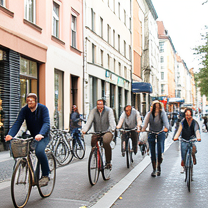
The picture shows a main street in Heidelberg, and it’s absolutely packed with people on bicycles. Seriously, everyone. There are families, young people, older folks, and even tourists. Not a single car in sight. It’s a totally different vibe than the streets back home, where cars are king. The TELC test asks you to describe what you see, and it’s more than just listing objects. You have to use descriptive language and show you understand why this is happening.
I spent ages looking at the picture, and I realized the key word is “sustainable.” It’s not just about bikes; it’s about a whole attitude towards living.
My First Attempt at Description – A Hilarious Mix-Up
I decided to try and describe it to my colleague, Klaus, who’s a native German speaker. I wanted to show him what I’d understood.
“Okay, Klaus,” I said, feeling a bit self-conscious, “Die Straße… ist sehr voll. Viele Leute… auf… Fahrrad. Und… Kinder! Und… alt?” (The street… is very full. Many people… on… bicycle. And… children! And… old?)
Klaus stared at me, utterly bewildered. “Du meinst, ‘Alter’,” he corrected patiently. “But ‘alt’ is wrong. You’re using it as an adjective. And you’re mixing up ‘Fahrrad’ and ‘Rad.’ They’re not the same thing!”
I felt my face turn red. It’s so easy to just throw words together, isn’t it? I quickly corrected myself, “Ja, ja, ‘Alter,’ thank you! ‘Fahrrad’ is correct. It’s… it’s a good example, right? A lot of people are using bikes.”
Key Vocabulary and Phrases – Let’s Get Specific
That whole experience highlighted the specific vocabulary I needed to really nail this kind of description. Here are some phrases I’ve found useful:
- “Es gibt viele…” (There are many…) – “Es gibt viele Menschen auf Fahrrädern.” (There are many people on bicycles.)
- “Die Leute benutzen Fahrräder für…” (The people are using bicycles for…) – “Die Leute benutzen Fahrräder für den täglichen Transport.” (The people are using bicycles for daily transport.)
- “Es ist eine nachhaltige Lösung.” (It’s a sustainable solution.) – This is crucial. It’s what connects the picture to the TELC test’s focus.
- “Die Stadt hat Fahrradwege gebaut.” (The city has built bicycle lanes.) – I’ve noticed this a lot in Heidelberg.
- “Das ist ein Beispiel für eine umweltfreundliche Stadt.” (This is an example of an environmentally friendly city.) – Another key phrase that would definitely be on the exam.
Real-Life Scenarios – Talking to Shopkeepers
It’s not just about formal descriptions. I actually had a conversation with a shopkeeper yesterday when I was buying some bread.
“Guten Morgen,” I said. “Ich möchte einen Brot. Haben Sie viele Fahrräder hier?” (Good morning. I would like a bread. Do you have many bicycles here?)
The shopkeeper, Herr Schmidt, smiled. “Ja, mein Kind, viele. Die Leute hier lieben ihre Fahrräder! Es ist gut für die Umwelt, nicht wahr?” (Yes, my child, many. The people here love their bicycles! It’s good for the environment, isn’t it?)
I replied, “Ja, stimmt! Es ist toll, dass so viele Leute Fahrräder benutzen.” (Yes, that’s right! It’s great that so many people are using bicycles.)
It felt really good to actually use that vocabulary in a real situation.
Making Mistakes and Learning From Them
I’m still making mistakes, of course. The other day, I accidentally asked a waiter, “Warum sind die Autos weg?” (Why are the cars gone?). He looked at me very strangely and explained patiently that the cars weren’t gone; they were parked elsewhere, in a garage or parking lot. It’s a small thing, but it highlighted the importance of really listening and understanding the nuance of the language.
Preparing for the TELC B1.2 – Focus on the Detail
Looking back at the Bildbeschreibung, I realize the TELC B1.2 test is really testing my ability to describe the reason behind what I’m seeing. It’s not just about identifying objects, but about understanding the cultural and societal factors that contribute to this scene. I’m going to keep practicing my descriptions, focusing on the key vocabulary, and trying to understand the bigger picture. And maybe, just maybe, I’ll be ready for that exam! Viel Glück! (Good luck!)


Leave a Reply