
My First Week Stuck in the Traffic: Learning German Through a Traffic Jam
Okay, so moving to Berlin was… a lot. The excitement of a new city, a new job, a new life quickly got replaced by the reality of, well, everything. And honestly, one of the biggest shocks wasn’t the bureaucracy or the U-Bahn delays (though those are pretty intense!). It was the traffic. Seriously, the traffic. It’s legendary. And it’s become my accidental German lesson.
The Bildbeschreibung – What Was I Looking At?
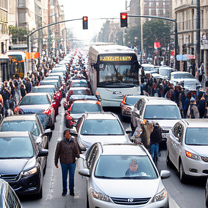
The TELC B1.2 Bildbeschreibung test shows a picture of drivers stuck in heavy city traffic. It’s a pretty common scene, actually. I actually experienced this firsthand last week, and it’s completely shaped how I’m practicing my German, especially around describing situations. Before, I was so worried about perfect grammar and complex sentences, but this has forced me to think about communication, really.
I spent a good hour just staring at the image, trying to describe what was happening. My initial attempts were, let’s just say, embarrassing. I kept saying things like, “Es gibt viele Autos… sehr, sehr viele…” which, while technically correct, sounded incredibly robotic and didn’t actually paint a picture.
My First Conversation – “Was ist das?”
I was talking to Sarah, my colleague from the office, trying to explain the picture to her. I said, “Da sind viele Autos. Sie sind…gefangen.” (There are many cars. They are… stuck.)
Sarah looked at me, a little confused. “Gefangen? Was bedeutet das?” (Caught? What does that mean?)
It hit me! I wasn’t using the right words. “Oh! Ich meine, sie sind im Stau!” (Oh! I mean, they are in traffic!)
She smiled. “Ja, das macht mehr Sinn! (Yes, that makes more sense!)“ And she started giving me suggestions: “Du könntest sagen, ‘Die Autos stehen fest’ – that’s a really common way to describe it.” (You could say, ‘The cars are stuck’ – that’s a really common way to describe it.)
Key Vocabulary – A Traffic Jams’ Worth
Learning the vocabulary surrounding traffic has been surprisingly helpful. Here’s what I’ve picked up:
- Stau: (pronounced ‘stow’) This is the word for traffic jam. Seriously, I’ve been using it constantly.
- Verkehr: (pronounced ‘fair-kehr’) This means “traffic” or “transport.” I heard a taxi driver say, “Der Verkehr ist sehr dicht.” (The traffic is very heavy.)
- Ampel: (pronounced ‘amp-el’) Traffic light. I nearly got a ticket because I didn’t check the Ampel before turning.
- Autobahn: (pronounced ‘ow-tob-ahn’) Highway. It sounds so impressive, but sometimes it’s just as congested as the city streets!
- Fahrzeug: (pronounced ‘fair-zhoo’) Vehicle. Pretty useful for describing anything from a car to a bus.
Misunderstandings and Funny Moments
The other day, I was talking to my landlord, Herr Schmidt, about the traffic. I said, “Es ist so viel Verkehr, es ist wie ein Monster!” (There’s so much traffic, it’s like a monster!)
He stared at me, completely bewildered. “Ein Monster? Was meinst du?” (A monster? What do you mean?)
I quickly explained that I meant it was incredibly dense and chaotic. He started laughing and said, “Ach, du musst dich erst an den Berliner Verkehr gewöhnen!” (Oh, you just have to get used to Berlin traffic!).
Practicing in Real Life – It’s More Than Just Words
The best thing about learning this way is that I’m actually using the language. I’m describing the delays to my friends, asking for directions when I get lost (which happens a lot), and even ordering coffee with a bit more confidence, knowing I can describe the situation if something goes wrong.
I’m still making mistakes, of course. I still struggle with prepositions like “in” and “an,” and I definitely need to work on my pronunciation. But every time I manage to describe the traffic effectively, even just a little bit better, I feel a small victory.
And who knows? Maybe this frustrating traffic jam is actually helping me become a more confident and fluent German speaker. Ich glaube es! (I believe it!)
Now, if you’ll excuse me, I’m going to go try and catch the next bus… before I get stuck in another Stau.


Leave a Reply