
My First Month in Germany: Tackling the Budget with a Little Help
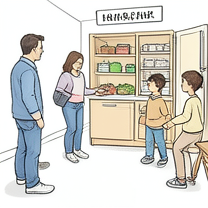
Okay, deep breath. Moving to Munich felt like stepping onto another planet. Everything’s bigger, more efficient, and… complicated when it comes to money. I’d spent weeks studying German, dreaming of ordering Käsekuchen with confidence, but nothing prepared me for the real-world shock of figuring out a monthly budget. It all started with this image in my TELC B1.2 practice book – a family sitting around a table, looking serious, talking about money. It suddenly felt incredibly relevant to my life!
The Conversation Starts
My wife, Sarah, and I were staring at the bank statement, utterly bewildered. We’d moved in with my Aunt Helga and Uncle Klaus for the first few months, which was a huge help, but we still needed to get a grip on our finances.
“Na, was haben wir denn so verbrannt?” (Well, what did we burn through?) Klaus asked, a little teasingly.
I felt a flush of embarrassment. “Äh… Ich glaube, ich habe zu viele Bier gegessen.” (I think I’ve eaten too many beers.) It was true. My first week, I’d celebrated a small professional success with a few too many Bier at the local Biergarten. Sarah translated, “He means he spent a lot of money on beer!”
Klaus chuckled. “Das ist nicht die Lösung!” (That’s not the solution!) He pulled out a notepad and pen. “Zuerst müssen wir herausfinden, was wir wirklich brauchen.” (First, we need to figure out what we really need.)
Key Phrases for Budgeting
That’s when I realised just how important learning the right phrases was. Here are some that have become my go-to:
- “Wie viel kostet das?” (How much does that cost?) – I asked this a lot at the supermarket! Especially when trying to understand the prices on things like Wurst (sausage) and Kohl (cabbage).
- “Ich kann mir das nicht leisten.” (I can’t afford that.) – I wanted a new pair of hiking boots, and after seeing the price of Bergschuhe, I realised I needed to be realistic.
- “Ich habe nur [amount] Euro.” (I only have [amount] Euros.) – This was crucial when I tried to buy a Fahrrad (bike) – a seemingly simple purchase turned into a negotiation!
- “Das ist zu teuer!” (That’s too expensive!) – I used this a lot with the shopkeepers! It’s a great way to politely push back on prices.
Realistic Spending – It’s Not Just Beer!
The conversation with Klaus really hammered home that it wasn’t just about the beer. We started tracking everything. Rent ( Miete), groceries (Lebensmittel), public transport (Öffentliche Verkehrsmittel – the U-Bahn is amazing!), and even little things like coffee (Kaffee) and newspapers (Zeitungen).
I made a mistake early on – assuming everything was roughly the same price. The Bio-Gemüse (organic vegetables) at the Edeka supermarket cost nearly twice as much as the regular vegetables! Klaus patiently explained that Bio meant “organic” and was often more expensive.
A Typical Day – My Spending
Let’s look at a typical day. I bought a Brötchen (bread roll) and coffee for €2.50, used the U-Bahn (€8), and had lunch at a small Imbiss (snack stall) – Currywurst (€5). That’s already €15.50! It was a much bigger number than I’d anticipated.
Learning from Mistakes
I also learned that being polite is key. I accidentally asked for a discount at a small Geschäft (shop) – something I’d been told to do in my German lessons. The shopkeeper, a friendly older gentleman named Herr Schmidt, smiled and said, “Nein, nein, das können Sie nicht verlangen. Es ist ein fairer Preis.” (No, no, you can’t ask for a discount. It’s a fair price.) He explained that small businesses often operate on tight margins.
It was a valuable lesson – respect the local customs and understand that things work differently here.
My Next Steps
I’m still figuring it out, but I’m feeling much more confident. I’m using a budgeting app, trying to cook more at home ( Ich koche selbst), and making a conscious effort to save. It’s challenging, but also incredibly rewarding. And who knows, maybe I’ll finally master the art of ordering Käsekuchen without breaking the bank! Viel Glück! (Good luck!)

Leave a Reply