
My Struggle (and Small Victories) with German Insurance – B1.2 Level
Okay, so here I am, a few months into living in Berlin, and let’s be honest, life is…complicated. Not in a dramatic, ‘lost-my-passport’ kind of way, thankfully. But navigating everyday things, especially things like insurance, has been a serious challenge. And, apparently, it’s a great test of my TELC B1.2 skills. I’ve been practicing my German by trying to understand these pictures – specifically, the ones for the Bildbeschreibung exam. It’s surprisingly useful!
The Picture: Insurance Comparisons Online
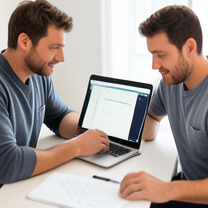
The image shows a group of people sat around a table, all staring intently at their laptops. One woman is pointing excitedly at her screen, another is frowning, and a third is looking bewildered. It’s clearly about comparing insurance offers. It’s a common enough sight in the Cafés here, actually. I’d seen it a few times and thought, “Right, that’s a good scenario to practice.”
First Attempts – A Hilarious Disaster
My initial attempts to describe the scene to a friend, Steven, were…embarrassing. I started with the obvious: “Es sind Leute am Tisch. Sie schauen Computer.” (It’s people at the table. They are looking at computers.) He looked at me like I was speaking a different language. “Ja, klar! Aber warum sind sie da?” (Yes, of course! But why are they there?) He pointed out I hadn’t even hinted at what they were doing. I realized I was focusing too much on the basic description and not adding any detail.
I tried again, more cautiously. “Sie vergleichen Versicherungen. Eine Frau zeigt etwas auf ihrem Bildschirm. Sie schaut begeistert.” (They are comparing insurance. A woman is pointing at something on her screen. She looks excited.) Steven chuckled. “‘Versicherungen’ is a bit formal for everyday conversation, you know? Try saying ‘Versicherungsangebote’ (insurance offers). And ‘begeistert’ – that’s a bit strong, isn’t it? Maybe ‘zufrieden’ (satisfied) would be better.”
Key Vocabulary: It’s All About the Details
That’s when I started to really understand the importance of specific vocabulary. I started noticing words everywhere. I heard people talking about:
- die Prämie (the premium)
- die Selbstbeteiligung (the deductible)
- die Leistungen (the benefits)
- die Vertragsbedingungen (the terms and conditions) – I heard someone groan dramatically after reading those!
I was practicing saying things like, “Ich möchte die Leistungen von Angebot A mit Angebot B vergleichen.” (I would like to compare the benefits of offer A with offer B.) It felt so much more natural than trying to just describe the scene.
A Real-World Misunderstanding (and a Helpful Correction)
Last week, I went to a local Supermarkt (supermarket) and overheard two older men arguing loudly. One was trying to explain something about die Haftpflichtversicherung (liability insurance) to the other. It was a complete mess of German! I desperately wanted to jump in and help, but I realised I wasn’t at the B1.2 level yet. I watched, feeling a bit helpless, as the other man finally interrupted and, in surprisingly clear English, said, “He means ‘liability insurance’ – it covers damage you cause to other people’s property.”
That was a huge wake-up call. It showed me how important it was to be able to understand the context and know when to step in and when to let someone else handle a difficult situation.
Practicing with the Exam Image – Little Steps
I’ve been focusing on the picture for the exam, practicing describing it in detail. I’ve created little sentences for each person: “Die Frau schaut auf ihren Laptop und scheint zufrieden zu sein.” (The woman is looking at her laptop and seems satisfied.) “Der Mann scheint frustriert zu sein.” (The man seems frustrated.) I’m even starting to use phrases like ‘es scheint, dass…’ (it seems that…) to add nuance.
The Goal: Confidence and Communication
Honestly, it’s still challenging. I stumble over my words, I mispronounce things, and I definitely still make mistakes. But with each attempt to describe the picture – and with the help of Steven, and the realization that even a small amount of precise German vocabulary can make a massive difference – I’m feeling a little more confident. And that, I think, is the most important thing for me, especially as I continue to build my life here. My next aim is to understand the whole dialogue, not just describing the picture. Wish me luck!
- “Viel Glück!” – That’s what Steven always says. And I think I need it!


Leave a Reply