
My First Real Encounter with German: A Car Repair and a Lot of ‘Wie?’
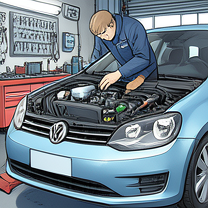
Okay, so I’ve been living in Munich for six months now, and honestly, some days I still feel like I’m just bobbing around in a sea of German. It’s a beautiful language, incredibly complex, and sometimes, unbelievably frustrating. I’m trying to get to B1.1 level for my work, and the TELC exam feels like a mountain right now. They gave us this picture – a mechanic fixing a Volkswagen – and I thought, “Right, let’s see what I can actually do with this.”
The Initial Panic – And a Very Confused Mechanic
I went to a small garage in Schwabing, hoping to just observe and maybe pick up some useful phrases. I walked in, feeling a bit ridiculous, and the mechanic, a really friendly man named Herr Schmidt, was working on a Golf. I wanted to say something, anything, to show I was interested.
So, I said, “Entschuldigung, Herr Schmidt, was machen Sie?” (Excuse me, Mr. Schmidt, what are you doing?).
He stopped, looked at me, and replied, “Ich repariere ein Auto.” (I’m repairing a car).
And that was it. My brain completely blanked. I just stared, completely lost. I managed a weak, “Ach… okay.” I wanted to ask about the part he was using, or the problem, but all I could manage was utter silence. It was mortifying! I quickly realized that even simple phrases feel enormous when you’re actively trying to use them.
Vocabulary Lessons – From Schraube to Bremsen
Herr Schmidt, thankfully, noticed my confusion. “Warum schauen Sie so verwirrt aus?” (Why are you looking so confused?). I mumbled something about wanting to learn German, and he surprisingly started explaining things in simpler German.
He pointed to a wrench and said, “Das ist ein Schraubenzieher. Ein Schraubenzieher.” (This is a screwdriver. A Schraubenzieher.) Then he showed me the brakes. “Die Bremsen – wichtig für die Sicherheit!” (The brakes – important for safety!). He used the word Bremsen a lot, and it started sticking in my head. We talked about other parts – die Reifen (tires), die Batterie (battery), das Motoröl (engine oil). I wrote down a little notebook, desperately trying to capture everything. I even asked, “Was bedeutet Motoröl?” (What does Motoröl mean?), and he patiently explained it’s the oil that keeps the engine running smoothly.
A Small Mishap and a Helpful Correction
Things got a little more complicated when I tried to ask about the price. I said, “Wie viel kostet das?” (How much does that cost?). Herr Schmidt looked at me strangely and said, “Nein, nein! Sie sagen: ‘Wie viel kostet es?’ (No, no! You say: ‘How much does it cost?’)
I felt my face turn red. It’s so easy to make these little mistakes! He corrected me gently, and I understood immediately. It wasn’t just the words themselves, it was the correct structure. That was a really important lesson – paying attention to the specific words and the grammar.
“Ich verstehe… fast!” (I understand… almost!)
By the end of my visit, I’d managed to ask a few more questions, understand some of the conversations between Herr Schmidt and a customer (who mostly just kept saying “Ja, ja, machen Sie”), and actually felt a tiny bit more confident.
I left with a new appreciation for the effort involved in learning German, and a slightly bruised ego. But I also had a useful phrasebook, a little notebook full of German words, and the realization that even a simple picture of a mechanic can be a fantastic tool for learning.
My next step? To actually fix that Golf! (Okay, maybe not. But I can definitely ask Herr Schmidt for help!) Ich werde weitermachen! (I will keep going!)


Leave a Reply