
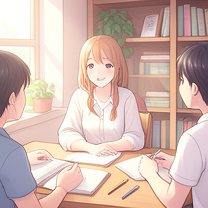
My First Semester: Talking About Colleagues and Classmates – It’s Harder Than It Looks!
Okay, so, I’ve been in Berlin for six months now. Six months of trying to speak Deutsch, of navigating public transport, of desperately attempting to understand the nuances of German office culture. It’s been amazing, frustrating, brilliant, and utterly bewildering, all rolled into one. And let me tell you, the biggest hurdle right now is talking about people – particularly my colleagues and classmates. Specifically, figuring out the personal pronouns. Seriously, it’s not just the verbs!
The Pronoun Problem: Why Am I Still Mixing This Up?
I thought I was getting the hang of it. I could order a coffee (“Ich möchte einen Cappuccino, bitte!”) and ask for directions (“Wo ist die U-Bahn?”) with relative confidence. But then I’d get into a conversation with someone at the office, and suddenly, my brain would just… blank. “Er ist sehr nett” (He is very nice) would turn into “Sie ist sehr nett” (She is very nice) when I meant the other person. It’s so embarrassing! I’ve made a few truly awkward moments, and I really don’t want to keep repeating the same mistakes.
“Du” vs. “Sie”: The Great German Debate
This is where it gets really confusing. “Du” and “Sie” – it’s like two different languages within the same language! I quickly learned that “Du” is for friends, family, and colleagues you’re close to. “Sie” is for formal situations, for people you don’t know well, and for superiors. I initially went way too formal with everyone. My supervisor, Herr Schmidt, kept giving me this slightly bewildered look when I addressed him as “Sie.” I finally realized I’d been using “Sie” when I should have been using “Du.” It’s a huge cultural difference!
Example Dialogue (Incorrect – Initial Mistake):
Me: “Wie geht es Ihnen?” (How are you?) – (To my colleague, Alice)
Alice: “Mir geht es gut, danke. Und Ihnen?”
Me: “Danke, auch Ihnen.” (Thank you, also to you.) – Ugh.
Correct Dialogue:
Me: “Wie geht es dir?” (How are you?) – (To my colleague, Alice)
Alice: “Mir geht’s gut, danke. Und dir?”
Me: “Danke, auch dir.” (Thank you, also to you.) – Much better!
Specific Vocabulary and Phrases I’m Using
Here’s a little list of phrases I’ve found really useful for talking about colleagues and classmates:
- “Er/Sie ist…” (He/She is…) – Super basic, but it’s the foundation.
- “Wie ist…?” (How is…?) – “Wie ist Herr Müller?” (How is Mr. Müller?) “Wie ist deine Schwester?” (How is your sister?)
- “Ich kenne…” (I know…) – “Ich kenne Markus aus der Uni” (I know Markus from university.)
- “Mein Kollege/Meine Kollegin…” (My colleague…) – “Mein Kollege arbeitet in Marketing.” (My colleague works in marketing.)
- “Das ist….” (That is…) – “Das ist meine Klassenkameradin, Lisa.” (That is my classmate, Lisa.)
A Real-Life Mishap (and How I Fixed It)
Last week, I was in a meeting with my team, and we were discussing a project. I wanted to say, “I think we should consider his suggestion.” So, I blurted out, “Ich denke, wir sollten seine Vorschlag berücksichtigen.” Everyone stared at me. My colleague, Sarah, gently corrected me. “Du solltest sagen ‘seine Vorschlag’ – du musst das Pronomen einfügen!” (You should say ‘his suggestion’ – you need to add the pronoun!). It was so mortifying, but she was incredibly patient and explained that I needed to say “seine Vorschlag berücksichtigen.” It’s amazing how quickly you learn from your mistakes – and how quickly you feel the embarrassment!
Tips for Actually Getting It Right
Okay, so here’s what I’m doing to try and get this right.
1. Listen Carefully: Seriously, pay attention to how native speakers use the pronouns. It’s so much more natural than trying to memorize rules.
2. Ask for Corrections: I’m now actively asking people to correct me. I’ve started saying “Bitte korrigieren Sie mich, wenn ich einen Fehler mache.” (Please correct me if I make a mistake.)
3. Write it Down: I’ve started keeping a little notebook where I write down phrases and dialogues to help me practice.
4. Don’t Be Afraid to Sound Stupid: Honestly, everyone has made mistakes learning a language. Embrace the awkwardness!
I know it’s going to take time and practice, but I’m determined to get this part right. Learning German is a marathon, not a sprint, and mastering these pronouns is a vital step. Wish me luck – I’m going to need it! Ich drücke Ihnen die Daumen! (I’m wishing you good luck!)


Leave a Reply