
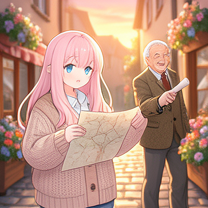
Navigating the Chaos: My First Forays into Asking for Directions in Germany
Okay, deep breath. Moving to Berlin was… a lot. It’s amazing, vibrant, and overwhelming all at the same time. One of the biggest hurdles, especially in the beginning, was just getting around. I’d spent weeks studying German vocabulary, but the real test came when I actually needed to ask for directions. Honestly, the first few times I felt like a complete idiot. But I’m learning, and I wanted to share what I’ve found actually works, and what totally didn’t.
The Initial Panic: My First Encounter
It happened last month. I was trying to get to a friend’s place in Neukölln – a notoriously confusing part of the city. I’d practiced the phrase “Wo ist…?” (“Where is…?”) a million times, but when I approached a woman on the street, all that came out was a panicked, “Entschuldigung! Wo… wo ist… die… Platz?” She stared at me blankly. Turns out, I’d just asked for the square (Platz – a public square). She finally pointed me in the right direction, thankfully, but it was a truly embarrassing moment. The important thing I realized was that people appreciate the effort, even if you’re completely wrong.
Essential Phrases: What You Need to Know
Let’s get down to the basics. These are the phrases I’ve found most helpful:
- “Entschuldigung, können Sie mir helfen?” (Excuse me, can you help me?) – Always start with this. It’s polite and signals you need assistance.
- “Wo ist…?” (Where is…?) – Obviously! Be specific.
- “Wie komme ich zu…?” (How do I get to…?) – This is incredibly useful if you’re trying to understand the route.
- “Ist das weit?” (Is that far?) – Good to know before you start walking!
- “Geradeaus?” (Straight ahead?) – Simple and effective.
- “Links?” (Left?) – You know, like in English!
- “Rechts?” (Right?) – Also like in English.
- “Ich bin neu hier.” (I’m new here.) – Adding this can make people more patient and willing to help.
Practical Scenarios and Dialogue Examples
Here are some conversations I’ve had, or that I’ve overheard and adapted:
Scenario 1: Asking for the Train Station
Me: “Entschuldigung, können Sie mir helfen? Wo ist der Hauptbahnhof?” (Excuse me, can you help me? Where is the main train station?)
Man: “Der Hauptbahnhof? Gehen Sie geradeaus diese Straße entlang, dann rechts.” (The main train station? Go straight down this street, then turn right.)
Me: “Geradeaus? Rechts?” (Straight? Right?)
Man: “Ja, geradeaus und dann rechts.” (Yes, straight and then right.)
Scenario 2: Getting Lost in a Side Street
Me: “Entschuldigung! Wie komme ich zu der Museumsinsel?” (Excuse me! How do I get to Museum Island?)
Woman: “Die Museumsinsel ist ziemlich weit. Sie müssen die Spree überqueren und dann links abbiegen.” (Museum Island is quite far. You need to cross the Spree and then turn left.)
Me: “Überqueren die Spree? Links abbiegen?” (Cross the Spree? Turn left?) – I realized I needed to ask her to repeat it slowly!
Common Mistakes (and How to Avoid Them)
I’ve made loads of mistakes. Here are a few:
- Over-complicating things: Don’t try to say everything perfectly. Simple phrases are much more effective.
- Not being specific enough: Saying just “das Museum” (the museum) is useless. Say “das Pergamonmuseum” (the Pergamon Museum) or “das Neue Museum” (the Neues Museum).
- Fear of asking for repetition: Seriously, don’t be afraid to say, “Bitte wiederholen Sie das, bitte!” (Please repeat that, please!). People are generally happy to help.
- Assuming everyone speaks English: It’s great to try, but relying on English when you’re still practicing German won’t help you in the long run.
A Helpful Tip: Visual Aids
I’ve found that using a map (even a paper one) while asking for directions makes a huge difference. Pointing to the location you’re trying to reach helps people understand exactly what you’re looking for. I now always have a little notepad with me to draw simple maps.
Final Thoughts (for Now!)
Getting around in Germany isn’t always easy, especially when you’re learning the language. But it’s a huge part of the experience, and every time I successfully ask for directions, I feel a little more confident and connected to this city. Don’t be afraid to make mistakes – that’s how I’m learning. And remember, a little politeness goes a long way! Ich glaube daran! (I believe in it!).


Leave a Reply