
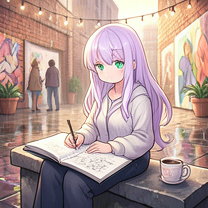
My Journey into German Art – And Why It’s Harder Than I Thought
Okay, so here I am, almost a year into living in Berlin, and I’m still wrestling with the German language. It’s amazing, frustrating, beautiful, and utterly baffling all at once. I’d always dreamed of visiting Germany, of seeing the art, and, honestly, of challenging myself. But let me tell you, discussing art publicly in German? That’s been a serious hurdle. It’s not just about learning vocabulary; it’s about understanding the nuances of opinion and the social customs around expressing them.
The First Encounter: The Mural in Kreuzberg
My first real attempt was in Kreuzberg, near the Markthalle Neun. There’s this incredible, massive mural depicting a protest scene – very Banksy-esque, but with a distinctly German flavour. I was admiring it with a couple of colleagues from work, Sarah and Thomas, and I wanted to say something about it. I’d been practicing phrases like “Das ist sehr interessant” (That’s very interesting) and “Ich finde es gut” (I like it), but when I opened my mouth, it came out like a mumbled disaster.
“Es… es ist… schön?” I stammered, completely unsure.
Sarah laughed gently. “Schön is a bit basic, Thomas! It’s a powerful piece. You could say, ‘Das ist eine sehr aussagekräftige Darstellung’ (That’s a very meaningful representation) or ‘Die Farben sind wirklich beeindruckend’ (The colours are really impressive).”
I felt my face burn. I’d completely butchered it. Thomas, ever the helpful one, added, “And don’t be afraid to use ‘Ich finde…’ (I think…) – it’s much more natural.”
Vocabulary for the Art World – It’s More Than Just “Schön”
Seriously, “schön” only gets you so far. I quickly realised I needed to build my art vocabulary. Here’s what’s been helping me:
- Stil: Style (e.g., “Der Stil ist sehr modern” – The style is very modern)
- Komposition: Composition (I learned this one after staring at a painting for a solid 20 minutes – “Die Komposition ist sehr interessant”)
- Farben: Colours ( “Die Farben sind lebendig” – The colours are vibrant)
- Ausdruck: Expression ( “Der Ausdruck des Künstlers ist sehr stark” – The artist’s expression is very strong)
- Interpretation: Interpretation ( “Wie interpretieren Sie dieses Bild?” – How do you interpret this picture?)
- Kunstwerk: Artwork ( “Das ist ein beeindruckendes Kunstwerk” – That’s a impressive artwork)
I started actively listening to how Germans talked about art – in galleries, on the radio, even just overhearing conversations. I noticed they often used more descriptive language than I was.
Common Mistakes and How to Avoid Them
Let me tell you, I’ve made plenty of mistakes. The biggest one? Over-complimenting everything. Germans tend to be more restrained with their praise. I once gushed, “Das ist unglaublich schön!” (That’s unbelievably beautiful!) to a relatively simple sculpture, and the man next to me looked utterly bewildered.
Thomas patiently corrected me: “It’s okay to express enthusiasm, but you need to tone it down a bit. Use words like ‘interessant’ or ‘beeindruckend’ (impressive) instead of ‘unglaublich’.”
Another mistake I keep making is assuming everyone will be interested in my opinion. Germans value directness, and sometimes I’m trying to soften my comments too much with phrases like, “Ich glaube…” (I think…), when a simple “Ich finde…” (I find…) is often more effective.
Talking About Art with Locals – A Practical Scenario
Let’s say I’m in a gallery and I really like a piece. Here’s how I would try to start a conversation:
Me: “Entschuldigen Sie, könnten Sie mir sagen, was der Künstler mit diesem Werk aussagen wollte?” (Excuse me, could you tell me what the artist was trying to say with this work?)
Local: (Might respond) “Nun, es geht um die Industrialisierung und den Verlust der Traditionen.” (Well, it’s about industrialization and the loss of traditions.)
Me: “Das ist sehr interessant. Ich finde die Darstellung der Landschaft sehr aussagekräftig.” (That’s very interesting. I find the representation of the landscape very meaningful.)
Notice how I’m using “Ich finde” – more direct. And I’m acknowledging their response and adding my own observation.
The Value of Just Listening
Honestly, I’ve realized that sometimes, the best way to learn about art and how to discuss it is simply to listen. I’ve spent hours just observing people in galleries, hearing their comments, and picking up the rhythms of the conversation.
Learning German art discussion isn’t just about memorizing words. It’s about learning a different way of seeing and expressing yourself. And, let’s be honest, it’s a hugely rewarding challenge. Next time, I’m aiming for a more confident “Komposition ist beeindruckend!” – wish me luck!

Leave a Reply